MOUNT MULTISPECIALITY DENTAL CLINIC
Better smile for a better tomorrow

We Welcome

| Patient Education |
|
| Instructions to be followed after the removal of tooth |
|
| An extraction is the removal of a tooth (or teeth) that is non-restorable, non-useful, or harmful to the patient.There exists many systemic precautions that should be discussed. Post extraction precautions include some of the following: |
- Pressure-bite on gauze or sponge over extraction site for at least 45 minutes after extractions.
- No rinsing or mouthwash use for at least 24 hours post extractions.
- Avoid any pressure that may dissolve clot such as using straws, smoking, etc.
- Avoid brushing the first 24 hours.
- Avoid alcohol for a few days.
- Place ice on the face for 20 minutes, alternating with 5 minutes off, for a period of 8 hours.
|
|
| Root Canal Treatment |
 |
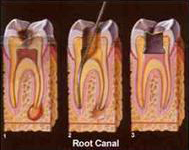 |
| A root canal treatment is necessary when decay or trauma affects the pulp or nerve of a tooth. The blood flow in the tooth rushes to the site of inflammation to aid the tooth. A pressure is created on the nerve endings, generating pain, which usually occurs at night or when lying down, and can be triggered by hot or cold. What occurs is a slow progression of decay traveling through the canal and settling at the end of the root. This results in an abscess (or swelling) at this site. |
|
| Periodontal Disease |
|
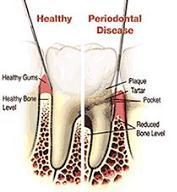
Periodontal disease begins when the bacteria in the sticky film which forms on the tooth surface, or plaque, causes gum inflammation. If the irritation is ignored, plaque will release toxins breaking down the natural fibers which hold your gums to your teeth, permitting even more bacteria and toxins to invade. Plaque deposits quickly harden into calculus or tartar, which is a rough, porous substance not removable with brushing. Over time, this progression can lead to severe inflammation, bone loss, gum recession and tooth loss.
Symptoms and signs include:
- Red, swollen, tender or bleeding gums
- Gum recession, or gums pulling away from teeth
- Loose or separating teeth
- Pus between the gum and tooth
- Persistent bad breath
- Bite changes
- Change in the fit of partial dentures.
|
 |
| If you have noticed any of the above signs or symptoms, you are advised to visit your dentist as early as possible for necessary treatment to be done. Together, we can win the battle against periodontal disease and maintain your wonderful, dazzling smile: gums and all. Now that's something to smile about. |
Teeth Cleaning (Prophylaxis)
Prophylaxis removes plaque and tartar from the teeth. This will makethe gums and teeth healthier. It is not uncommon for patients to note that teeth appear slightly more sensitive after a dental cleaning. The reason for this is that plaque and tartar coat the tooth surface and shield them from substances in the mouth. It is important for one to brush and floss after every meal to prevent buildup of plaque and tartar. |
| Dental Implants |
|
| Dental implants provide a foundation for the restorative dentist to replace missing teeth to form and function. Facial contours and tooth space is also maintained by replacing missing teeth. Implants are built on titanium posts, which are inserted into the jawbone where the teeth are missing. There are many different types of implants and the choice is made upon examination, the degree of space, and the amount of remaining bone. Once the implant is placed, healing may take six months, after which, it acts as if it were a tooth root substitute. |
 |
| Cervical abrasion |
|
Abrasion is the wear of teeth caused by surfaces other than teeth which is most commonly associated with tooth brushing on the cervical margins of the teeth. This lesion is usually caused by a combination of erosion, attrition, abrasion. The typical V - shaped lesion develops along the cervical margins of canines and premolars, it is less common around other and rare on palatal surfaces of the teeth. |
| Crowns (Caps) |
|
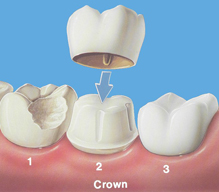
It is a procedure where a tooth is covered to strengthen a damaged tooth. The tooth may have been damaged by decay, or have a previous restoration that has fractured. Once a tooth has had a root canal, it then may be "crowned" if sufficient tooth is missing or if the dentist feels that the tooth will last longer by protecting it with the crown.
Developing a crown involves several phases. First, the dentist prepares the tooth and a temporary is fabricated and used to temporize the tooth while the crown is being processed in a dental laboratory. Second, the permanent crown is inserted. Failing to return to have the permanent crown placed can cause damage to the underlying tooth due to weakness and poor fit of the temporary crown. |
 |
| Digital X-rays |
|
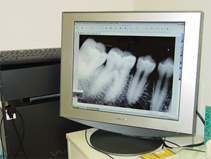
To improve your care we've invested in a new way of looking into your mouth-a procedure that's fast, and incredibly precise - digital x-rays. What's even more amazing is that we get an image immediately that is large, clear, and accurate, right next to your chair.ready for discussion. Digital x-ray technology speeds and simplifies the diagnostic part of your treatment, and most importantly allows us to provide a much higher level of care. |
Digital x-rays use 50-90% less radiation than old-fashioned x-rays. Additional benefits include the elimination of old fashioned dark room chemicals. The highly detailed image of your teeth on our computer screen, can be rotated, magnified, adjusted for contrast, and even color-coded. Further, we can store it on our computer files, thus saving paper. For insurance purposes, referrals or patient education, it can be accurately reproduced any number of times. In summary, digital x-rays are faster, cleaner, and allow us to provide better quality care. |
 |
|
|
|
|
| |
|
|